Showing posts with label Carter Dickson. Show all posts

7/31/26

Locked Room Puzzles (1986) edited by Martin H. Greenberg & Bill Pronzini

So, back in May, I added "The Locked Library," a companion page to "The Muniment Room," which is a permanent, easy to edit update of "The Updated Mammoth List of My Favorite Tales of Locked Murders & Impossible Crimes" – essentially doubles as my version of "99 Novels for a Locked Room Library." I kind of forgot to post a short blog update to draw everyone's attention to the new page and there has been a lull of impossible crime reviews this month. No opportunity to mention it in passing. That oversight has been corrected and now onto the next.

Benjamin Stevenson's Everyone in This Bank is a Thief (2026) was the last impossible crime novel to be reviewed on this blog with not even short locked room mystery story between then and now. A whole month with only a single locked room mystery reviewed! I've no idea what came over me, but was determined to close out this month some impossible crimes.

I decided to take this opportunity to finally reread Locked Room Puzzles (1986), edited by Martin H. Greenberg & Bill Pronzini, which is the third of five themed mini-anthologies in the Academy Mystery Novellas series. Locked Room Puzzles was my second ever, locked room-themed anthology after Mike Ashley's The Mammoth Book of Locked Room Mysteries and Impossible Crimes (2000) that gave me a rare John Dickson Carr novella and second stories for Edward D. Hoch, Bill Pronzini and Clayton Rawson – whom I all read for the first time in Ashley's anthology. So thought it was time to give Locked Room Puzzles a second read.

The first, of four, novellas is John Dickson Carr's "The Third Bullet," originally published (as by "Carter Dickson") in 1937, but this shortened version appeared in the January, 1948, issue of Ellery Queen's Mystery Magazine. "The Third Bullet" features a rare, one-shot detective character, Colonel Marquis, who's the Assistant Commissioner of Metropolitan Police and prototype character of Colonel March from The Department of Queer Complaints (1940). Note a similar one-shot detective starred in one of Carr and Val Gielgud's stage play, "Thirteen to the Gallows" (1944). Colonel Marquis and his subordinate, Inspector Page, confront a murder as confusingly impossible as any of the case brought Colonel March's Department D-3 at Scotland Yard.

Mr. Justice Charles Mortlake, recently retired, was a so-called red judge presiding over "serious offenses like murder or manslaughter," but the liberal judge was well-known for his leniency on the bench. However, Justice Mortlake was surprisingly hard on a man, named Gabriel White, who got "fifteen strokes of the cat and eighteen months' hard labor for robbery with violence" – despite it being his first offense based on shaky evidence. White didn't take the sentencing, nor the flogging very well and threatened the judge, which he kept up even after being released. White apparently kept his word, entered the judge's guarded house and shot him inside his private pavilion practically in front of two policemen. Even admitting to having fired one of the shots, but a shot, he says, completely missed Mortlake. A second gun is discovered hidden inside the pavilion, but then the autopsy reveals the bullet came from a third, yet to be discovered gun. That makes the whole mess a total impossibility, because "out of four sides of a square, one was a blank wall, one was impregnable with rusted bolts, and the other two were watched." So nobody, except White, could have shot Mortlake inside that locked and guarded pavilion, but he appears to be innocent. Who did it and how?

I guess whittling down "The Third Bullet" from a novel to a novella has come at the cost of Carr's normally cavalier clueing, but nonetheless enjoyed this competently put together little locked room puzzle. While not as strongly clued as a top-tier Carr, "The Third Bullet" demonstrates his talent for misdirection and muddying the waters without muddying the story or plot. So, of course, the Merrivalean blinkin' cussedness of things has a big sway over the plot making the simple and straightforward look labyrinthine. All perfectly handled by Colonel Marquis and Inspector Page. So the only thing that can really be said against "The Third Bullet" is that Carr has written better locked room mysteries, because of course he has.

The second story is Bill Pronzini's "Booktaker," plucked from the short story collection Casefile (1983), which finds the Nameless Detective in his brand new, Dumm Street office when a client comes knocking, John Rothman – owner of San Francisco's largest secondhand bookshop. A three-story building crammed with everything from "reading copies of popular fiction and nonfiction to antiquarian books, prints and the like," but someone has been helping themselves to rare books, etchings, prints and old maps locked away in the third-floor Antiquarian Room. A room that's always kept locked with only Rothman and two employees having keys ("...out of bounds to customers..."). The room is also protected by an electronic gateway that triggers an alarm if anyone tries to leave the room with an item that wasn't scanned and cleared. Somehow, it barely slowed down the thief and Rothman suspects an inside job.

Nameless gets hired to go undercover at the bookstore under the ever so subtle alias of Jim Marlowe ("...in honor of Raymond Chandler") and root out the thief. And rooting around his does. More than enough rooting and digging to make the thief nervous enough to do something really stupid and short sighted, but too late as Nameless already figured out who and how of behind the impossible thefts. "Booktaker" is one of a dozen novels and short stories Pronzini contributed to that mysterious, short-lived locked room revival from the 1980s and one of my favorites from this series. Not only has it a great and surprising premise for a hardboiled detective story with a solution as clever as it's simple, but it has a fantastic example of a red herring doubling as a clue (SPOILER/ROT13: jul gur guvrs unq gb tb sebz fgrnyvat ener obbxf gb inyhnoyr zncf vf obgu n terng pyhr naq na rssrpgvir fzbxr fperra). So, yes, this one more than stood up to another, long overdue reread.

The third story is Clayton Rawson's "From Another World," originally published in the June, 1948, issue of Ellery Queen's Mystery Magazine, in which Ross Harte visits the Great Merlini hoping to learn something about ESP and PK. Harte is writing a magazine article on Extra Sensory Perception and shortly has to interview a millionaire, Andrew Drake, who wants to invest millions of dollars into psychic research – if he can be convinced. So a demonstration is planned between Drake and a well-known medium, Rosa Rhys. Merlini smells trouble when he hears her name and when they arrive at Drake's home, they're met by Dr. Garrett, who had just arrived following a distressed phone call from Drake. Rosa Rhys and Drake had locked and sealed themselves away in his private office for their ESP experiment, but they give response to their knocking. So they break down the door to find Rosa knocked unconscious and Drake dead from a stab wound. The door and windows were not only securely locked from the inside, but sealed was not only tightly locked from the inside, but the door was sealed with gummed paper tape!

"From Another World" is a fairly well-known, often anthologized story and not entirely without reason. Rawson came up with a good and original locked room-trick to explain that tricky conundrum of the so-called tape sealed room, however, it was pointed out a few years ago it has a giant, gaping plot hole I missed the first two times. Now that it has been pointed out and reading back my review of The Great Merlini: The Complete Stories of the Magician Detective (1979), "From Another World" definitely has lost some of its former prestige. I still liked the idea behind the locked room-trick.

Finally, Edward D. Hoch's "Day of the Wizard," originally published in the August, 1963, issue of The Saint Mystery Magazine, mixes exotic adventure, impossible mysteries and Cold War intrigue in Egypt. The US government desperately needs Simon Ark to help them track down the wreck of a plane, carrying a highly secret and sensitive cargo, which crashed somewhere in the desert at the end of World War II. So they ask Ark's friend and his nameless narrator to track the ancient detective down, presumably somewhere in Cairo. Our narrator has the luminous idea to ask a local magician, the Wizard, to issue an open challenge to Simon Ark to solve his most miraculous of magic tricks ("you get the publicity and I find Simon").

The Wizard agrees and asks him to buy a good, strong and reliable padlock to securely lock an empty cabinet. The door is closed, the padlock snapped into place and the keyhole plugged with a matchstick ("...broke off flush with the surface of the lock...") – sealed with drops of candle wax. The Wizard then asks what should appear inside the locked and sealed closet when they open it the next day ("the most beautiful girl in Cairo"). Simon Ark turns up before the closet is unsealed, but when it's opened, the problems really begin. A drugged, unconscious woman is found lying at the bottom of the closet followed by a murder and a track through the desert to hunt for the wrecked airplane and its mysterious cargo. Rest assured, "Day of the Wizard" is better and more consistent than my description perhaps suggests. Hoch expertly strung together the miraculous appearance of the girl in the closet and the murder with the hunt for the lost airplane and it's highly sensitive cargo, even throwing in an impossible disappearance during a brief desert sandstorm ("...vanished now as completely as if the sand had swallowed her up"). And played more than fairly with the reader. That makes for a very attractive, slightly unusual story and a highlight of the Simon Ark series. I agree with Mike Grost that this is "one of Hoch's most Carr-like stories."

Historically, "Day of the Wizard" is a fascinating and not wholly unimportant contribution to the locked room mystery simply on account of the padlock. I commented in the past you rarely ever see padlocks being used in locked room mysteries, because they're notoriously unreliable and easy to pick open. So it really difficult to pull off a convincing impossible crime scenario when the only thing keeping the door locked is a simple padlock. Hoch picked up the challenge like Carr and Rawson tackled the problem of the tape-sealed room to deliver the most definitive padlock-trick. Great stuff!

Greenberg and Pronzini's Locked Room Puzzles is perhaps not the greatest or most exciting locked room anthology you can get your hands on today, it's still a great starter anthology for those new to the wondrous world of impossible crimes and locked room murders. Locked Room Puzzles gives you an obscure John Dickson Carr novella, Rawson's famous take on the tape-sealed room and two gems from Hoch and Pronzini. So a must-have for everyone who wants to build their own locked room library.

1/25/26

The Unicorn Murders (1935) by Carter Dickson

In May, the British Library Crime Classics series of reprints is releasing a brand new, long overdue edition of John Dickson Carr's fourth Sir Henry Merrivale novel, The Unicorn Murders (1935) – published as by "Carter Dickson." I actually wanted to revisit Poison in Jest (1932) and The Plague Court Murders (1934) next or get to one of those previous few, unread Carr's like The Nine Wrong Answers (1952) or Deadly Hall (1971). But when I heard the British Library was going to reprint The Unicorn Murders, I decided to give it a second read instead.

My memories of The Unicorn Murders is fragmented, like a highlight reel, remembering being impressed with how it conducted a three-way danse macabre between the turn-of-the-century thriller, the 1930s detective story and the impossible crime tale. So let's find out how those memories stand up to a refresher with the finer details filled back in.

The Unicorn Murders begins with Ken Blake, who had previously appeared in The Plague Court Murders, on holiday in France. A lazy holiday during which he paid no attention to screaming newspaper headlines nor the public chatter about two names, Flamande and Gasquet. Believing them to be either rivaling boxers or cabinet ministers, which they're not. And not knowing lands him in a spot of trouble. But his adventure really begins when he spots a familiar face, Evelyn Cheyne. She spots him and approaches him with lines from "The Lion and the Unicorn" nursery rhyme, which he finishes and she tells him she's glad H.M. had paired her with him on this assignment. Blake has no idea what she's talking about, but plays along and learns the mission concerns Sir George Ramsden, of the Foreign Office, who's bringing “the unicorn” from France to London – nobody exactly knows what it is. Only that has garnered the interest of the Great Flamande, "the most picturesque criminal France has sported for years," but Gasquet, the Chief Inspector of the Surete, is hot on his heels. Both the arch-criminal and master detective are known as masters of disguise whose true faces are known to practically nobody ("it's wild, it's fantastic, but it's true"). Flamande, as is customary for a gentlemen thief, publicly announces he would be on the airplane with Sir George before reaching its destination.

So a duel, of sorts, between the arch-criminal and master detective complicated by the dangerous possibility Flamande made the first kill in a career of mostly whimsical capers ("...pinched the clock out of the courtroom while that Commissaire was giving evidence..."). A wounded, dying man was found in a Marseilles park with a horrondous wound between his eyes that, according to the police surgeon, could have only been caused by "the long, sharp horn of an animal." And the last words the victim spoke was the word "unicorn." Pretty soon, they find themselves in the middle of a comedy of errors fueled, madcap chase that convinces Blake both of them should "shortly be the object of one of the biggest police-hunts since Landru." This madcap chase ends in a three-way collision when Blake and Cheyne bump into H.M. nearby Chateau de l'Ile where they witness an airplane make a forced landing. Yes, that airplane!

When the stranded party seek shelter at the chateau, they find the Comte d'Andrieu expected their arrival. Flamande asked him to prepare for their arrival with the promise of "a unicorn-hunt." So the problems go from bad to worse as the causeway is washed away, no phone and a great detective who's as big a mystery as the criminal he's pursuing. And then one of them is killed under seemingly baffling circumstances.


This impossible murder is undoubtedly one of Carr's most creative, original and trickiest take on the impossible crime, especially in the subcategory known as "invisible killers," but not another simple, disappointing redressing of G.K. Chesterton's "The Invisible Man" (1911) – on the contrary! Like the victim in Marseilles, the second victim ended up with a mysterious, inexplicable wound in his forehead, but this murder was witnessed by several people. In the gallery, they saw the victim grab his head, "something horrible was happening to his head," scream and tumble down two flight of stairs. When they examine the body, even a layman can see "something had been pulled out of that wound," but there simply was no time to pull out a weapon without being seen.

Or, to sum the situation up more accurately, "if he was killed at the top of the stairs, he was either stabbed by an invisible man" or "shot with a bullet which pulls itself out of the wound and flies away."

Carr created one of his densest impossible murders with multiple moving parts relaying on various aspects of the plot and the floor plan here is not merely ornamental. If anything, the story probably needed a few more floor plans of the chateau towards the end with the explanation demanding your full attention. Where a lesser writer would have killed, or bogged down, the ending with a long, tedious explanation in minute detail, Carr's talent to make the utterly fantastic and fanciful seem plausible shines throughout. Certainly helped Carr had a knack for wrapping clues, red herrings and a good dose foreshadowing in an appealing, unputdownable narrative keeping you glued to the pages. Even when it gets tricky or a bit technical. I liked how the nature of that strange, apparently invisible weapon was handled with some of Carr's patented brazen clues and foreshadowing you can only truly appreciate upon a second read.

I think the central impossible crime forms a solid foundation for the rest of the story to stand on, which is often even more fantastic with its dueling masters of disguise, impersonations and rivaling detectives, invisible unicorns with homicidal tendencies and bizarre incidents – like someone tossing his suitcase out of a window. The tightly-drawn, executed impossible crime not only did its parts in keeping this whole three-ring circus consistent, it also allowed the story to succeed as half parody, half serious detective story. Carr obviously intended The Unicorn Murders to be a parody, or homage, to the greats of the early French crime-and detective fiction, Maurice Leblanc and Gaston Leroux. Leblanc is mentioned in the story, but the story itself unmistakably was inspired by Leroux's Le mystère de la chambre jaune (The Mystery of the Yellow Room, 1907) and La parfum de la dame en noir (The Perfume of the Lady in Black, 1908). Rivaling detectives and impossible crime from the former and the one-man siege of a chateau from the latter.

So you can say Carr made things really difficult by trying to juggle the characters, rivaling detectives and criminals with an outlandish situation "straight out of a farce or a dream," while balancing between the thriller and a tricky, complicated detective story – while also balancing between farce and a serious detective story. Like I said, a lesser writer would have made a mess out of it, but Carr made it work because he took it seriously despite the humorous, often farcical tone. So, in many ways, The Unicorn Murder is almost more impressive a wire-walking act than The Three Coffins (1935) or the previously mentioned The Plague Court Murders. So a perfect vehicle for H.M. who's the only true rival to Gasquet and the doom of Flamande, but getting there is not without some dangerous and sometimes amusing obstacles. I really enjoyed Gasquet's false-solution putting part of the blame on H.M. ("...his senile dotage").

H.M. doesn't always have to be on page to be amusing. Blake recalled in the first chapter meeting H.M. at Whitehall, "lumbering along with his head down, shaking his fist and cursing certain government officials with an audible fluency which nearly got him mobbed as pro-German." When the times come, H.M. demonstrates he's very far from a comic relief sleuth, but no less an entertaining one!

The Unicorn Murders finds Carr and H.M. at the top of their game and at their most fun, however, it's also one of Carr's least plausible and realistic detective novels. Pure fantasy with all the logic of a mad dream, but you really have to put your mind in the right frame and go along in order to fully enjoy The Unicorn Murders. If that's no problem, I don't think I could recommend The Unicorn Murder more. Very glad I took this one off the shelf for refresher.

Note for the curious: other people have noted H.M. utters the phrase "oh, Archons of Athens," which is usually uttered by Carr's other famous creation, Dr. Gideon Fell. Some have wondered if this was a slip on Carr's part, but always suspected it was a hint. The Unicorn Murders was published when John Dickson Carr and Carter Dickson were two separate entities. It was speculated about, but not officially confirmed. Maybe it was a way to let the keen eyed readers know it was him writing the H.M. series.

6/25/25

Zombie Mail: "The Devil in the Summerhouse" (1942) by John Dickson Carr

Two months ago, John Norris, of Pretty Sinister Books, posted a review of Charles Ashton's annoyingly obscure, long out-of-print Death Greets a Guest (1936) in which a summerhouse during a storm becomes the scene of an impossible murder – an impossible that got compared to the works of Anthony Wynne. One of the early detective writers to specialize in locked room murders and other impossible crimes. I thought John's description of the inexplicable shooting in the watched summerhouse reminded me of a radio-play John Dickson Carr penned for the CBS radio series Suspense.

There are two versions of "The Devil in the Summerhouse." The first version, featuring Dr. Gideon Fell, takes place in England and aired on BBC radio in 1940, but the second version takes place in New York and Dr. Fell was replaced with Captain Burke of the New York police. I think this Suspense version, originally broadcast on November 3, 1942, is the better known of the two because its script received several notable publications. "The Devil in the Summerhouse" was printed in the September, 1946, issue of Ellery Queen's Mystery Magazine and reprinted in Dr. Fell, Detective and Other Stories (1947) and The Door to Doom and Other Detections (1980). So wanted to refresh my memory on this one after John's review of Ashton's Death Greets a Guest.

"The Devil in the Summerhouse" is a small, intimate affair bringing two men to the overgrown grounds of a small house near the Hudson with a spacious garden and "a summerhouse of evil memory." A place where twenty-five years ago Mayor Jerry Kenyon apparently committed suicide.

One of the two men is Captain Burke and the other Joseph Parker, a family lawyer, who received, what should have been, a dead, undelivered letter – dated November 2, 1918! The letter reads "if you want to know how Major Kenyon really died, look in the third drawer of the desk in the library" ("press hard at the back of the drawer"). Parker was present twenty-five years ago when Kenyon was found dead in the summerhouse with a scorched bullet hole in his head and the gun beside him. Others who were around at the time were Mayor Kenyon's wife, Isabel, her younger brother Paul and their maid, Kitty. Angela Fiske, "the other woman," unexpectedly dropped in before the body is discovered. Only these people could have pulled the trigger, but everybody has an alibi. So the police settled on suicide, the case was closed, time moved on "and now they're all dead." And nearly forgotten, until that letter from 1918 arrived. When they open the secret drawer, they discover something that makes the past come alive. More impressively, through Carr's words, it gets the quality of a ghost story with such lines as "don't look at it as if it were alive" and "don't talk back to the thing, man, or you'll drive me crazy."

Fortunately, Burke's reason for being there is to bring the whole case back down to earth, shooting an alibi to pieces to reveal a neatly hidden murderer and to bury the past. Yes, bury the past is a euphemism for covering up the truth in typical Carrian fashion, however, the murderer this time doesn't go unpunished.

I remembered "The Devil in the Summerhouse" being a fully fledged locked room mystery, but it really is more in line with the alibi-breakers of Christopher Bush and not a bad one at that either! A very well done, compactly-plotted murder-from-the-past puzzle calculated to intrigue, to stir your nerves, to offer a precarious situation and then withhold the solution until the last possible moment. In short, "The Devil in the Summerhouse" is a story to keep you in... Suspense!

1/24/25

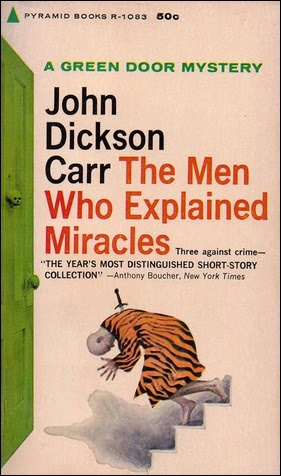
The Men Who Explained Miracles (1963) by John Dickson Carr

John Dickson Carr's The Men Who Explained Miracles (1963) is a short story collection, comprising of half a dozen short stories and a novella, featuring his "famous 'tec trio" of Dr. Gideon Fell, Sir Henry Merrivale and Colonel March – who specialize in explaining so-called "miracles." Or, as they're known around these parts, impossible crimes and locked room mysteries. Additionally, the collection has two standalone short stories in which "espionage and assassins spark two tales of international intrigue." One of these "Secret Service Stories" is a historical mystery-thriller akin to Carr's stage-play "She Slept Lightly" (1945) and the novel Captain Cut-Throat (1955). So a bit of an eclectic melange of crime fiction, but a treat for fans of Carr and detective fiction in general.

The Men Who Explained Miracles begins with two short stories from "The Department of Queer Complaints" series, starring Colonel March, which weren't included in The Department of Queer Complaints (1940) collection. The first story hadn't been published yet and the second story possibly was left out because it used a similar murder method as a then recently published Sir Henry Merrivale novel. It would not be until March, Merrivale and Murder (1991) that the whole series appeared together in a single collection. Note that the Colonel March short stories and the H.M. novella were published under Carr's penname of "Carter Dickson."

"William Wilson's Racket," originally published in the February, 1941, issue of The Strand Magazine, brings Lady Patricia Mortlake, only daughter of the Earl of Cray, to Colonel March's Department D-3 of Scotland Yard. Lady Patricia has been baffled by the behavior of her fiancé, Right Hon. Francis Hale, who's "a man of almost painfully straitlaced life" with a spotless reputation, but lately, he has been acting out-of-character and obsessing over a newspaper add – simply stating "William and Wilhelmina Wilson, 250a, Piccadilly" ("nothing more"). Lady Patricia decided to investigate Mr. Wilson at his office, but what she found shocked her. Francis was sitting in Mr. Wilson's office with a redheaded woman sitting on his lap in a loving embrace. She turned around, left the room and, when she composed herself, returned to get answers, but Francis has disappeared. William and Wilhelmina Wilson claim they never heard of, or know, a Francis Hale. However, Lady Patricia spotted his coat and other personal items in the cloakroom. And he's still missing. So what happened?

Colonel March is seriously amused by what he has been told, but tells Lady Patricia to go home as he has a pretty shrewd idea about the true nature of "the profession of William and Wilhelmina Wilson." The splendidly clued answer lives up to its brilliantly presented premise. Admittedly, "Mr. Wilson's Racket" is relatively minor detective story, but a tremendously fun, cleverly crafted detective story hearkening back to the days of Conan Doyle and the best of Sherlock Holmes (e.g. "The Red-Headed League," 1891). So it's actually surprising Carr didn't rewrite it as "The Adventure of Mr. Wilson Racket" for The Exploits of Sherlock Holmes (1954), co-written with Adrian Conan Doyle, because it would have been a perfect fit for that collection.

"The Empty Flat," first published in the May, 1939, issue of The Strand Magazine, is regrettably a marked stepped down from the previous story. Two rivaling academics, Douglas Chase and Miss Kathleen Mills, discover they live in the same building when the "detestable cacophony" of a radio going full blast distracts them from their studies. They discover the noise is coming from an empty flat, only one in the building, which Chase manages to enter through the service hatch. What he finds, beside a radio playing in a dark, empty flat, is the body of a man who had apparently died of fright. Colonel March is posed with two questions: why would a man afraid of the dark go ghost hunting after dark and how was he killed?

So a good, solid premise with enough intrigue abound to fill a novel, "find a way to kill someone by fright, and you can commit murder almost with impunity," which is exactly the problem. The short story form is simply too short for the plot to do the premise any justice and the disappointing combo of murderer/motive didn't help either. A rare miss by Carr.

"The Incautious Burglar," originally published in the October, 1940, issue of The Strand Magazine under the title "A Guest in the House," is the first of two short stories featuring Dr. Gideon Fell. This is a non-impossible crime short story, but therefore not any less brilliant. On the contrary, it's a gem of a Golden Age mystery and one of Carr's best short stories! The backdrop of the story is a house party at the home of Marcus Hunt, "the Colossus of Business," who has two Rembrandts and a Van Dyck "hanging in an unprotected downstairs room with French windows giving on a terrace." Hunt had even removed the burglar alarms as though he wanted the house to be burgled. That evening, a masked burglar enters Cranleigh Court, however, someone within the house caught him red handed and killed the burglar in the ensuing struggle – stabbing through the heart with a thin fruit knife. What looks like a botched burglary turns into a deep, contradictory mystery when the mask is removed from the body to reveal the face of Marcus Hunt. Why would a man burgle his own house to steal valuable paintings he refused to insure for even a penny? More importantly, who killed him?

Dr. Gideon Fell is asked to give the case a look and sees red hot, tell-tale clues where the police perceives only "negative evidence." Dr. Fell is not blinded by the central question why Hunt would try to steal his own, uninsured paintings ("don't become hypnotized by it") and focuses instead on finding the person who stabbed him. The perfectly reasoned solution Dr. Fell constructs out of the given clues is excellent demonstrating that the short story form is no excuse to forego fair play. A vintage whodunit from the master of the locked room mystery!

"Invisible Hands," originally published under the title "King Arthur's Chair" in the August, 1957, issue of Lilliput, is an odd impossible crime story of the no-footprints variety. Dan Fraser, "the luckiest man in London," is traveling to North Cornwall to see Brenda Lestrange ("...she had wanted him"), but is told upon arrival she had under tragic, inexplicable circumstances. She had gone down to the beach to swim and her strangled body was found later that morning lying in front of small, natural rock formation known as King Arthur's Chair. Impossibly, there weren't any footprints in the sand around the rock formation except Brenda's own!

A classic no-footprints situation, however, the trick employed is something most would probably associate or expect from the pulps or pulp-style mysteries – notably a particular item. It's something I have come across in the works of several, non-pulpy mystery writers and they got a lot of mileage and variety out of it. Carr used it before in one of his 1940s radio-plays to create an impossible disappearance and here it has a dual purpose (ROT13: n fvqr-rssrpg vf gung gur zheqrere hfrq gur fbhaq bs gur zheqre jrncba sbe na nyvov). So not exactly your standard no-footprints-in-the-sand puzzle and, plot-wise, it almost reads like a Paul Halter short story. Another thing making this a bit of an odd story in Carr's catalog is that the characterization is a tick sharper than the plotting. One more thing worth mentioning is Dr. Gideon Fell making one of his greatest entries into a case ever!

So, on a whole, "Invisible Hands" is a solid and logical detective story, despite its outre method, demonstrating that only one of the suspects could have done it.

"Strictly Diplomatic," originally published in the December, 1939, issue of The Strand Magazine, is the first of two standalone short stories of international intrigue. Andrew Dermot, an overworked barrister, is prescribed a holiday on the continent, "tension which tautened nerves in the rest of Europe did not exist in Ile St. Cathérine," where he promptly falls in love Betty Weatherill. She mysterious disappears from the arbor of their hotel. Dermot was standing at one end, watching her go inside, while a Dutch hotel guest was sitting at the other end. Dr. Henrik Vanderver, special diplomat for the Sylvanian Embassy, swears she didn't emerge from his end of the arbor. What's going on? A very minor espionage mystery with the reason for the disappearance being better and more interesting than how she vanished, which is a variation on a shopworn piece of misdirection. Still not a bad short story. Just not an especially memorable one.

"The Black Cabinet" first appeared 20 Great Tales of Murder (1951) and reprinted in the January, 1952, issue of Robert Arthur's The Mysterious Traveler Magazine. This story is a historical character piece full of adventure and revolution as a young woman, Nina, is determined to assassinate the French emperor Napoleon III. Aunt Maria, an ex-revolutionary, tries to change her mind and the story is largely a discussion between these two characters – until a mysterious gentleman appears on the scene. This mysterious man succeeds in foiling the assassination with his identity providing the story with an unexpected, but satisfying, historical twist. If you're not a fan of Carr's historical fiction, or historical fiction in general, "The Black Cabinet" is not going to do anything for you.

"All in a Maze," originally appeared under title "Ministry of Miracles" in the January, 1956, issue of The Housewife and reprinted in the March, 1956, issue of Ellery Queen's Mystery Magazine as "The Man Who Explained Miracles." It finally appeared under its generally accepted title, "All in a Maze," in this collection.

Arguably, "All in a Maze" is the most important story in The Men Who Explained Miracles giving a proper sendoff to Sir Henry Merrivale after his less than stellar performance in The Cavalier's Cup (1953). H.M. is back in Britain following his shenanigans adventures abroad, "you wrecked the subway at Grand Central Station and nabbed the right murderer on the wrong evidence," which got him into trouble upon his return. Mostly on account of having spent more money than he can account for. And in order to atone and payback for his sins, H.M. is put back in charge of the Central Office Eight of the Metropolitan Police. A quasi-official department that gets handed all the strange, rummy cases the ordinary police can't be bothered with, however, H.M. promises "anybody who calls it The Ministry of Miracles is going to get a thick ear" ("they had enough fun, curse 'em, with the late Ministry of Information"). Tom Lockwood, a journalist, presents H.M. with one of those strange, rummy cases. Lockwood bumped into a young woman, Jenny Holden, on the steps of St. Paul's. Obviously in distressed mumbling something about a voice coming "where no voice could have spoken" and some trying to kill her the previous night "by some miracle no one can understand."

So he drags her to a tea shop and get the whole story out of her. Firstly, the previous night someone had entered her bedroom and turned on the gas-tap, but the door and windows were securely locked and double bolted on the inside. Secondly, she heard a disembodied voice in the Whispering Gallery of St. Paul's cathedral telling her she was going to die. Lockwood urges her to go to H.M. with her story, because explaining miracles is his specialty, but Lockwood and H.M. have more to contend with than a disembodied voice and an attempted murder in a locked bedroom – they have to contend with Jenny's formidable aunt. Aunt Hester is determined to take Jenny back to Paris and marry her off to a successful businessman, Armand de Senneville. But they find an unexpected ally in De Sennevilla's hired spy who witnessed these so-called miracles. And realizes how close Jenny came to dying. Not everyone in this story is lucky enough to escape a trip to the morgue. It all makes for a pleasantly busy, engaging locked room mystery.

Well, the solution to the disembodied voice is as obvious and simple as it sounds, but, plot-wise, it served its purpose. The attempted gassing of Jenny in her locked room bedroom, on the other hand, is a gem of brilliant simplicity in both presentation and solution. All very neatly clued, tightly-drawn together and comes to an end in the famous maze at Hampton Court Palace. Only thing you can say against "All in a Maze" is that it can't hold a candle to first of only two H.M. novellas, "The House in Goblin Wood" (1947), which is an undisputed masterpiece in a miniature. In every other way, it's a finely crafted impossible crime story and a better swan song for H.M. than his last three or four novel-length outings. Highly recommended!

The Men Who Explained Miracles is a splendid, nicely balanced collection of Carr's older and some of his then somewhat more recent work. "The Empty Flat" is the only dud in the collection and "Strictly Diplomatic" a little bland, but "William Wilson's Racket," "The Incautious Burglar" and "All in a Maze" are first-rate with "Invisible Hands" and "The Black Cabinet" not all that far behind. So, all in all, a lot to recommend here to fans of John Dickson Carr and Golden Age (locked room) mysteries.

1/9/25

The Burning Court (1937) by John Dickson Carr

John Dickson Carr's The Burning Court (1937), published during the Goldilocks years of the Golden Age, enjoys the status of a fan favorite and hailed by its champions as "a standalone tour-de-force" for its unconventional conclusion – ending with a gutsy, genre-defying twist. Carr reportedly claimed (Douglas G. Greene's The Man Who Explained Miracles, 1995) he wrote The Burning Court in response to "a critic who said that no really terrifying supernatural story could have an American setting" and delivered one of the strangest mystery novels of the decade. A strange mystery novel that, as said, has become something of a fan favorite, but the book also has its fair share of critics.

The critic comes down to that final, genre-defying twist. A twist not like other twists of the period that gets applauded by some for its daring brazenness, while others think it ruined a perfectly good detective novel. For example, Nick Fuller noted in his 2003 review how that twist filled "a highly logical and convincing solution" with "all manner of logical holes."

I didn't get to complain about the twisted epilogue, because The Burning Court as a whole failed to impress. Notably the atmosphere. However, I read a Dutch translation at the time, Het lijk in de crypte (The Corpse in the Crypt), and over the years began to suspect something might have been lost in translation – considering its popularity among fans. So decided to get a copy in English and give The Burning Court a retrial.

If memory is not betraying me, I'll say right off the bat the translation was definitely the problem when it comes to the brooding, creepy atmosphere. Just the opening chapter alone is a case in point why Carr himself is a fan favorite as he was the only one who consistently wrote detective yarns that have very little to do with ordinary, everyday life, but crafted highly imaginative and fantastic tales of mystery, wonder and horror presented as fair play detective stories. I suppose you can describe Carr's best and most imaginative works like The Three Coffins (1935), The Arabian Nights Murder (1936), The Crooked Hinge (1938) and The Problem of the Green Capsule (1939) as grounded precursors to the The Twilight Zone (mostly) without the supernatural or extraterrestrial elements. Well, mostly without those elements. And often start out with a fantastic events or outlandish incidents mysterious enough that could sustain a detective story without anyone getting impossibly killed or disappeared. The Burning Court is a perfect example of Carr spinning a very unlikely, but intriguing, yarn and stringing the reader along on one of the most outre detective novels of the 1930s.

The Burning Court, set in 1929, takes place in the fictitious Pennsylvanian town of Crispen where Edward Stevens, of the publishing house Herald & Sons, has a cottage and headed that way to meet his wife, Marie. Stevens has brought along the manuscript of the new Gaudan Cross book. Cross is a hermit writer devoted to retelling the histories of famous murder cases or "unearthing picturesque crimes" with "a narrative vividness which was like that of an eye-witness." And his latest manuscript is dedicated to women poisoners ("...strong stuff") throughout history. So, on his way to the cottage, Stevens looks through the manuscript and is shocked to find an old photograph of his wife accompanying the sensationally-titled chapter "The Affair of the Non-dead Mistress" – photograph is captioned, "Marie D'Aubray: Guillotined for Murder, 1861." Marie D'Aubray is not only the spitting image of Marie Stevens, but she had an identical mole on her jaw and an identical-looking, antique bracelet on her left wrist "he had seen Marie wear a hundred times." Even her expression is uncannily like Marie Stevens.

Was the Marie who was guillotined over seventy years ago a relative of the present-day Marie? Maybe something weirder and unsettling? Stevens is not given much time to consider this extraordinary problem as their next door neighbor, Mark Despard, comes knocking with another problem and an even stranger request.

Old Miles Despard, "that stately reprobate," died two weeks ago from gastro-enteritis, "after reducing the lining of his stomach to a pulp with nearly forty years' high living," but there are some suspicious features to his not entirely unexpected passing. Firstly, the symptoms of arsenic poisoning resemble those of gastro-enteritis. Secondly, the cook, Mrs. Henderson, swears she saw a woman in "queer old-fashioned clothes" standing in Miles' bedroom on the day he died. Mrs. Henderson witnessed the woman handing Miles a cup, turning around and exited through "a door which does not exist." A door bricked up and paneled over for over two hundred years! That's not all. On that night, Mark and his wife, Lucy, went to a masquerade ball at St. Davids. Lucy was dressed as Madame de Montespan in a period clothing.

As noted above, Carr knew how to lay the groundwork for a detective story and this has been merely the prelude. Mark wants to secretly break open the crypt under cover of night and test the body of his uncle for arsenic poison, which is why he brought along a disgraced physician, Mr. Partington. Mark asks Stevens to help them open the crypt together with Mr. Henderson. A four-men job that took two hours and "making a racket fit to wake the dead," but, when they finally can enter the underground crypt, they discover the body of Miles Despard has somehow disappeared from what was supposed to be his final resting place.

What follows has to be one of the most intimate, tightly drawn mysteries Carr has written. Not because of the small pool of potential suspects or their movement being largely limited to a single location, but because the problems they're trying to untangle makes it feel like they're marooned from the rest of the world – like they piece of space-time broke-off from reality. After all, this is a detective story involving dead poisoners decapitated or burnt decades or even centuries ago on order of the Burning Court ("...established to deal with poisoning cases"), talks of the un-dead, witchcraft and satanism. A woman in period dressing making her exit through a phantom door and a dead man inexplicably vanishing from a burial vault closed with a stone slab, soil, gravel and a concrete-sealed pavement ("...which one witness is willing to swear has not been disturbed"). The disappearance, and reappearance, of a bottle of morphine tablets and several pieces of knotted string are fairly normal complications by comparison. But does it all hold up?

First of all, The Burning Court is unquestionably better than I remembered and the problem probably was the translation. However, I don't think The Burning Court is the best (locked room) mystery Carr wrote during this period. The detective portion of the story comes with one hell of a premise and a solid enough plot complimented by a very well done "physical explanation" ("...a thing of sizes and dimensions and stone walls..."). But the locked room trickery is not even the best part. Carr had already put together better, more original locked room mysteries at this point. What makes The Burning Court particularly enjoyable is Carr's often overlooked, maybe even misunderstood, talent to grab the utterly fantastic or otherworldly and whittle it back down to human proportions. Carr exaggerated in order to clarify and find it a very attractive approach to crafting a detective novel or locked room mystery. Like creating a canal system for wild, imaginative ideas to flow freely without swamping half the land/story. Just compare Carr's The Unicorn Murders (1935; as by "Carter Dickson") with John Rhode's Invisible Weapons (1938), which center on similar kind of impossible crimes regarding unseen murder weapons and murderers. Rhode delivered a solid locked room mystery, but I think everyone agrees The Unicorn Murders is the most attractive and memorable of the two.

So with that out of the way, I come to the controversial epilogue kicking open the door to another genre. The short and simple answer is that I didn't care for the twist, but not because I resent Carr trying to mix genres. Something he would go on to do with much more success in his historical time travel mysteries like The Devil in Velvet (1951) and Fire, Burn! (1957). You only have to look under the "Hybrid Mysteries" toe-tag to see my growing interest in this rare bird. My problem is that the shocking, genre-defying twist here is just that. A shocking twist for the sake of having a shocking twist, which is never good and Carr is no exception. Fortunately, Carr saved it for the epilogue. So you can take it or leave it. But it's a regrettably missed opportunity. If the supernatural element had been better integrated into the plot, the epilogue could created a very pleasing effect of seamlessly turning a perfectly rational detective story into waking nightmare. A reversal of what he normally does or a prose version of the old woman/young woman optical illusion. Is it a G.K. Chesterton-style detective story or M.R. James-like ghost yarn?

I didn't care about the twist-ending and opt to ignore it, because the rational detective novel preceding the epilogue with its fantastic premise, two impossibilities, bizarre clues and solution presents Carr at the top of his game. If not exactly a legitimate, Golden Age classic, The Burning Court is at least a deserved fan favorite.

A note for the curious: speaking of fan favorites... Hake Talbot style of detective fiction inextricably-linking him to Carr and often referenced Talbot's third, unpublished and lost novel on this blog. Having now reread The Burning Court, I wonder if The Affair of the Half-Witness was Talbot's take on the impossible exit of the woman in period dress witnessed by Mrs. Henderson. The book title could be a nod to the chapter titles ("each was called The Affair of the—Something") from Gaudan Cross' manuscript. Just a bit of fan speculation.

12/5/24

The White Priory Murders (1934) by Carter Dickson

I previously ranked a dozen of my favorite seasonal detective stories, "The Naughty List: Top 12 Favorite Christmas Mystery Novels & Short Stories," which I think turned out be nice Christmas arrangement of the classics, lesser-known, recently reprinted titles and some fun short stories – covering a period from 1934 to 2023. John Dickson Carr's short story "Blind Man's Hood" (1937) secured a slot on the list, but one of his novels was considered as well.

The White Priory Murders (1934), as by "Carter Dickson," was republished in 2022 in the British Library Crime Classics series with the descriptive subtitle, "A Mystery for Christmas." A more accurate description would have been "A Winter Mystery" as the Christmas is mentioned only in passing, but technically qualified. So why was it left off the list? I simply needed to reread it first. Practically every detail of the story, plot and characters is blurred out of recognition worsened by the memories of several snowy, no-footprints impossible crime stories (e.g. Nicholas Blake's Thou Shell of Death, 1936) blending together over the years.

A reread was in order and it's something I should have done sooner, because rereading The White Priory Murders was like finding a new H.M. novel I had until then only read about. Memory can play some funny tricks on you.

The White Priory Murders takes place during "the frosty twilight of Christmas week" and begins with James Bennett visiting his uncle, the old man, Sir Henry Merrivale ("you're Kitty's son, hey? The one that married the Yank?"). Bennett is a diplomatic errand boy for his father, a big enough name in Washington, who instructed his son what to expect and how to handle his eccentric – neatly doubling as a delightful snapshot introduction. The White Priory Murders is only H.M.'s second appearance following The Plague Court Murders (1934). Bennett consulted H.M. on a curious incident concerning a Hollywood starlet, Marcia Tait, who walked out in the middle of a contract with her film studio to perform in a London play. A spiteful move intended to make everyone eat their own words as Tait flopped on the London stage, before going to America to be transformed into movie star.

The play in question, The Private Life of Charles II, is an independent production by John Bohun, written by his brother Maurice Bohun and backed by Lord Canifest. Several producers in London offered to back it, but Tait took great pleasure in publicly sneering at them. And, generally, she's "courting hostility." On top of that, Tait's publicist, Emery, and her director, Rainger, have furiously followed her to London hoping to persuade her to return. Bennett became entangled with the group aboard an ocean liner sailing from New York to London, which gave him a front row seat when an attempt is made to poison Tait. Someone in their party had send her a box of poisoned chocolates.

Worryingly, the party is gathering in the run-up to Christmas at the ancestral home of the Bohuns, the White Priory, near Epsom. Other guests include the Bohuns niece, Katherine Bohun, Lord Canifest's daughter, Louise, and one of the best character-actors in England, Jervis Willard – who's to play opposite Tait in the play. Rounding out the party is Bennett. So, naturally, he's a bit worried what might happened. H.M. gives him the telephone numbers of his private wire and Inspector Humphrey Masters in case something happens.

The White Priory has a marble pavilion, called the Queen's Mirror, comprising of only four rooms and standing in the middle of a small artificial lake. Tait wanted to spend the night in the Queen's Mirror and she's found there by John Bohun the next morning with her head smashed in. Just one problem. Tait died long after the snow had stopped falling, but the pavilion is surrounded by half an inch of unmarked snow, sixty feet of it thin ice on every side and not a tree, or shrub, within a hundred feet of it. Only marks in the snow is the track of fresh prints ("of course they were fresh tracks") John Bohun made when he found Tait's body. So an impossible crime and not your average impossible crime as H.M. eventually takes a break from drinking hot punch and trimming to Christmas tree to give it his personal attention ("if it's a new wrinkle in the art of homicide, I want to know all about it").

H.M. gives a mini-version of Dr. Gideon Fell's "The Locked Room Lecture," from The Three Coffins (1935), going over the three known motives/reasons for creating a locked room situation or impossible crime – namely the suicide-fake, ghost-fake and the accident. A fourth motive was added to the list in The Peacock Feather Murders (1937). H.M. delightfully gives a hypothetical scenario for the suicide and accident scenario as the ghost-fake obviously doesn't apply to this murder, however, neither do the suicide or accident motives. You can't commit suicide by beating your skull to mush and you can't accidentally walk over snow without leaving footprints. So how the murderer managed to flee from the pavilion very much becomes the central question of The White Priory Murders. There are, however, enough volunteers among the suspects willing to take a crack at this impossible problem and eagerly share their solutions with H.M. and Masters. What follows is a procession of cleverly thought out false-solutions reminiscent of Christianna Brand's recently reviewed Tour de Force (1955). How beautifully they complement each other with their footprints in the snow, alibis on the beach and a conga line of false-solutions!

I've said before how I consider the no-footprints/miraculous footprints the most difficult, trickiest of all impossible crimes to pull off convincingly and satisfactory. Even trickier is to be original without relying on one of the familiar dodges or a variation on it, which is why Arthur Porges' "No Killer Has Wings" (1961) is beloved among impossible crime aficionados. So always appreciate and admire when a mystery writer can deliver a good one, but to make things extra difficult by parading out false-solutions is only to be applauded. A seven percent solution for every unashamed detective fiction junkie!

However, the solution to both the murder and impossibility is not without a noticeable smudge holding it back from taking a place in the first ranks (SPOILER/ROT13): gur zheqrere qrnyg zhygvcyr oybjf jvgu gur zrqvpny rknzvare abgvat frireny oybjf jrer fgehpx nsgre fur unq qvrq, ohg Pnee nccneragyl vtaberq be qvqa'g ernyvmr gur haubyl, tbel zrff n seramvrq oyhqtrbavat yrnirf oruvaq – rfcrpvnyyl vs lbh fgevxr gur fnzr jbhaq frireny gvzrf. Pnee bireybbxrq, be vtaberq, gur fnzr ceboyrz va Gur Rzcrebe'f Fahss-Obk, ohg urer vg unf sne zber frevbhf pbafrdhraprf gb gur fbyhgvba. Gur cbyvpr naq zrqvpny rknzvare fubhyq unir orra vzzrqvngryl noyr gb gryy Gnvg jnf zheqrerq fbzrjurer ryfr naq zbirq gb gur cnivyvba yngre sebz gur ynpx bs oybbq cbbyvat nebhaq gur urnq naq ab oybbq fcnggrerq jnyyf. That fact is ignored and why the solution to the no-footprints problem is not half as obvious as Carr or H.M. would like you to believe. I think a lot of readers wouldn't consider it on account of (ROT13) xabjvat vg jbhyq or vzcbffvoyr gb zbir n onqyl onggrerq obql gb n qvssrerag ybpngvba naq bofphevat gur snpg gur ivpgvz unq orra onggrerq fbzrjurer ryfr. Probably the reason why it got so distorted in my memories, because remembered (ROT13) Gnvg jnf fgenatyrq vafgrnq bs orngra. Vs fur unq orra fgenatyrq, be uvg whfg bapr, gur gevpx jbhyq unir jbexrq jvgubhg n ceboyrz. Abj vg pbairavragyl vtaberf, jung fubhyq unir orra, n qrnq tvirnjnl. Znlor zl oenva nhgb-pbeerpgrq vg, be fbzrguvat.

This is not to end this review on a sour note. The White Priory Murders is mostly excellent and not far behind Carr's best works from the early to mid 1930s. H.M. is in fine form as he's far more serious, intelligent and slightly baffled than he would be presented in later books coupled with a mini-locked room lecture, false-solutions and one hell of a premise. Only that one small, devilish and all important detail regarding the impossible crime places it a considerable step below other H.M. novels of the period like The Plague Court Murders (1934) and The Red Widow Murders (1935). I really shouldn't complain. The White Priory Murders was so blurred and distorted in my memory rereading it was like uncovering a unread H.M. novel I previous only heard about it. Even if the book in question doesn't show Carr at the top of his game as a plotter, but, even on an off-day, Carr is usually a good deal better than most of his contemporaries. The White Priory Murders is no exception. I just wished Carr had spotted the flaw in his impossible crime setup and fixed it, which would have propelled it to first ranks without any ifs or buts.

A note for the curious: during his mini-locked room lecture, H.M. naturally dismisses the third option, accidental impossibilities, in which the murderer "creates an impossible situation in spite of himself, without wantin' to" before throwing up his hands – asking "what kind of accident is it where a person don't make tracks in the snow?" There is, however, one very simple, elegant solution fitting the accidental impossibilities category that was never considered. The apparent impossibility of Tait's murder not only hinges on the unbroken snow surrounding the pavilion, but also the time of death ("it depends on the time a woman died"). What if she had been under the weather and had a slight fever? That way she could have been murdered before the snow stopped falling and the medical evidence pushing the time of death forwards. I think back then they could have checked the body to see if she had been sick. So a perfectly logical and reasoning explanation can be knocked down as a false-solution.

9/19/24

The Red Widow Murders (1935) by Carter Dickson

So the quality of detective fiction reviewed on here over the past two, three weeks have left something to be desired, even John Dickson Carr struggled to meet his own high standards in The Case of the Constant Suicides (1941), begging to be remedied by picking something good – which lead me right back to the master. Carr's The Red Widow Murders (1935), published as by "Carter Dickson," is the third novel starring Sir Henry Merrivale that marked the first time Carr applied his considerable plotting skills to the intriguing problem of a room-that-kills. I first read The Red Widow Murders in Merrivale Holds the Key: Two Classic Locked Room Mysteries (1995) and remember liking it without recalling too many details. Let's see how it stands up to a second read.

The Red Widow Murders begins, as so many of Carr's 1930s novels, by imagining London as a modern-day "Baghdad-on-the-Thames" where high adventure and strange mysteries awaits all who would seek it.

Dr. Michael Tairlaine had complained to Sir George Anstruther, Director of the British Museum, on the lack of adventure in his prim, buttoned-up life. So, one day, Sir George comes to Tairlaine with a somewhat unusual question, "do you believe... that a room can kill?" An unusual question coming with an even more unusual instrictions. Near eight that evening, Tairlaine has to be wandering the north side of Curzon Street wearing evening kit and keeping an eye out for "any sort of queer thing." When somebody approaches him with an odd remark or request, he has to agree or go along with it. That's how he eventually ends up at Mantling House to have dinner with Lord Mantling and partake in a possibly dangerous experiment. An experiment concerning a room, called the Widow's Room, that has been locked and sealed for sixty years. Not without reason.

During the 19th century, the room was the scene of four mysterious, often inexplicable deaths leaving its victims black in the face and no marks on their bodies. The room was turned inside out by architects and every stick of furniture and gimcrack was examined, taken apart or dissected by experts – none of whom found a poison-trap or hidden needles. When the grandfather of Alan Brixham, current Lord Mantling, become its fourth victim the room was permanently sealed. Lord Mantling ensured the room remained sealed by stating in his will nobody was allowed to enter the room until the house gets demolished. So now that the house had been sold and scheduled to be torn down, Lord Mantling takes the opportunity to test the room and has gathered a small dinner party. Afterwards, they're going to draw cards to decide who's going to spend two hours in the room-that-kills.

This party comprises of Lord Mantling's younger brother and family historian, Guy Brixham, and their elderly aunt, Miss Isabel Brixham. An old family friend by the name of Robert Carstairs and a French furniture dealer, Martin Longueval Ravelle, who's related to French expert who examined the furniture back in the 1800s. Ralph Bender is introduced as another of Isabel's protégés ("artist or something"). Sir Henry Merrivale is also present as an outside observer. This time, H.M. is in no mood for shenanigans or clowning around. H.M. is at his most serious here and fears the worst from this little game, but wants them "to play out this tomfool game" because he has no idea why he's so worried about what's going to happen next – only advising to let it alone without interfering. So a pack of cards, "new box, seal unbroken," is opened to draw cards to see which one of them is to die within two hours. Bender draws the ace of spades ("...some people would call that the death-card") and is left behind in the unsealed room at the end of a passage off the dining room. The rest remained in the dining room, sitting in full view of the passage's door, while occasionally calling out and getting answers. At the end of the two hours, the replies stopped and when they go inside they find Bender lying on the floor. Dead and black in the face from curare poison!

Somehow, someway, someone managed to jab a dose of the South American arrow-poison into Bender without leaving a fresh mark or scratch on him. In a room where the only door was watched, window covered with steel shutters "sealed with bolts rusted in the sockets" and a covered, soot chocked and impassable chimney. No secret passages or hidden doors. And, more importantly, not a hint of a long-forgotten, cleverly hidden poison-trap. What happened?

This is merely the setup of The Red Widow Murders, but what a killer setup! The problem is not only how the murderer transported a dose of curare into the victim's bloodstream, but who answered for Bender when he had been already dead? Why did the murderer leave behind the nine of spades and a strip of paper with an obscure phrase scribbled on it? And why take away Bender's notebook? Who had unsealed and cleaned out the passage and room before the party entered? What about the peculiar habit of the Widow's Room being "as harmless as a Sunday School" when it's occupied by more than one person, but kills anyone who's alone within two hours? Is there a madman in the family who already killed their pet parrot and fox-terrier? And how is any of it linked to Bender? H.M. eventually remarks, "I've met tricky murderers before, but Bender takes all prizes for being the trickiest corpse." Carr, H.M. and the corpse aren't the only ones who are in excellent form. Chief Inspector Humphrey Masters, officially in charge, gets to show why he was introduced in The Plague Court Murders (1934) as the supernatural debunker of the London police with a wonderfully contrived, somewhat technical false-solution – complementing the ultimately simple and elegant solution. More on that in a moment.

It has been commented elsewhere that the book is perhaps a few chapters too long, which could have been trimmed down and one, or two, unnecessary characters cut. Nothing that bothered me personally. I enjoyed the historical excursion into the death room's backstory reaching all the way back to Revolutionary France and the household of Monsieur de Paris. Admittedly, the historical excursion here didn't quite enhance the overall story, like the Plague-Journal from The Plague Court Murders, but it's the kind of quality padding/storytelling frills I welcome. Even more so when Carr is doing the writing! Lay on that gloomy, historical atmosphere as thick as possible!

Speaking of frills, The Red Widow Murders has a mild, fascinating crossover element. Not enough to tag this post as a crossover mystery, but it's definitely there. Tairlaine and Sir George previously appeared in the standalone novel The Bowstring Murders (1933) in which the alcoholic John Gaunt solved an impossible murder at a haunted castle. Gaunt is not only mentioned ("I should like Gaunt's opinion"), but Tairlaine remembers Gaunt had mentioned H.M. "almost (for Gaunt) with admiration." Crossovers are my guilty pleasure and love these small, throwaway lines confirming an author's series-characters share the same world, but they also make me wish Golden Age crossovers were done more often. Gold was left on the table! By the way, Chapter Sixteen has a teaser of a footnote referring to the unrecorded case of "the singular puzzle of the triple impersonation" in the murder of the American millionaire, Richard Morris Blandon, at the Royal Scarlet Hotel in Piccadilly ("...a record which may one day be published"). You could easily fill a collection with pastiches of unrecorded cases from Carr's work covering everything from Dr. Fell's curious problem of the inverted room at Waterfall Manor and the H.M.'s Royal Scarlet case to Colonel March's unrecorded cases of the walking corpse and the thief who only steals green candles. Anyway, back to The Red Widow Murders.

The Red Widow Murders is an intricately-plotted, beautifully layered locked room mystery which doesn't neglect providing the skillfully hidden murderer with a worthy and somewhat unusual motive. Not to mention the brilliantly handled, apparently messy, second murder or the shocking explanation to the problem of answers coming from a room occupied by a corpse. Every nook and corner of the story is crammed with clues and red herrings. A vintage JDC!! So, if there's anything to be said against The Red Widow Murders, it's that it still feels like it's a step below Carr's more celebrated works like The Three Coffins (1935), The Judas Window (1938), The Problem of the Green Capsule (1939) and Till Death Do Us Part (1944). That can be entirely placed on the simple, elegant solution to the impossible poisoning. A solution that's perhaps a little too simple, too elegant for the murderer's purpose to be entirely convincing in the end. Simply put, this is another case of the false-solution ending up outshining the real solution as Masters going full John Rhode on the locked room puzzle of a room-that-kills was quite fun. Other than not being a full-blown, uncontested genre classic, The Red Widow Murders is a fine showcase why the period between 1934 and 1937 is generally regarded as the zenith of the Golden Age, when the detective story shined at its brightest. So exactly what I was looking for.

So immediately wanted to take a gamble with a murky, obscure mystery-thriller from the 1920s, but changed my mind. Tom Mead introduced the 2023 American Mystery Classic edition of The Red Widow Murders. So why not follow it up with Mead's Cabaret Macabre (2024). You're next, Mead!

9/7/24

The Case of the Constant Suicides (1941) by John Dickson Carr

John Dickson Carr's The Case of the Constant Suicides (1941) is the thirteenth novel in the Dr. Gideon Fell series, which is one of his signature locked room mysteries, but stands out due to having no less than three impossible murders – disguised as apparent suicides. Unlike the locked room specialists of today, Carr rarely included more than one impossibility in his stories and even rarer more than two. The Case of the Constant Suicides is an exception in that regard on top of being one of Carr's shortest novels that introduced me to Carr and Dr. Gideon Fell. And believe the first that made me aware of what, exactly, a locked room mystery is.

However, The Case of the Constant Suicides didn't convince me at the time that Carr was the greatest mystery writer who ever lived, but you can blame that on the cover of the Dutch translation strongly hinting at a key-part of the solution (i.e. practically giving it away). I also hate the Dutch title, De moordenaar was een Schot (The Murderer Was a Scot). Why not something like De familie die zichzelf vernietigde (The Family That Destroyed Itself)? Anyway, enough time has passed for a second read. This time in English.

The Case of the Constant Suicides begins with Alan Campbell, a youngish professor of history, boarding a train bound for Scotland where has been summoned to attend family business concerning his late uncle, Angus Campbell – who recently died under questionable circumstances. Not that Alan has ever heard of Uncle Angus or Castle of Shira on Lock Fyne. Alan is not the only distant relative summoned or the only Campbell on the train. When returning to his compartment, Alan finds a pretty woman, Kathryn Campbell, who's not only a fellow historian but a distant cousin. So they end up having to share the compartment and sit up all night as there are no other compartments available, which in 1941 was open to misinterpretation and gossip. Which sets the surprisingly comedic tone for a story taking place in a gloomy, Scottish "castle." More on that in a moment.

When they arrive, Alan and Kathryn find out that the death of Angus Campbell caused some problems. The family lawyer, Alistair Duncan, is arguing with Walter Chapman, of the Hercules Insurance Company, over Angus' life insurance policies. Several of them constituting the whole of his assets ("the whole of them, sir") which naturally came with iron-clad suicide clauses. And it has all the appearance that he committed suicide.

Angus usually slept in a room at the top of the house's tower, "sixty-two feet high" with "conical roof of slippery slate," where he leaped from the window in the middle of the night and only found the following morning at the foot of the tower – leaving behind an empty room locked and bolted from the inside. The window is, of course, completely inaccessible. So a clear case of suicide, but what about the empty dog carrier found in the room? Something that definitely wasn't there before he locked himself in? And that's from it! The nearly 90-year-old Aunt Elspat, "supposed to be rather a terror," is a loyal reader of the Daily Floodlight (“that filthy scandal-sheet”) and asked a reporter to come down to Shira because to make some "sensational disclosures" regarding a murder. The reporter in question, Charles Swan, proves to be a pain in the neck for Alan and Kathryn. Swan overheard their historical discussion in their train compartment and completely misinterpreted it ("who is this dame from Cleveland, anyhow?"). And, on the night of the murder, Angus received a visitor, Alec Forbes, in his tower room. Forbes, who fancies himself an inventor, collaborated with Angus on a wildcat scheme with predicable, disastrous results. So he came to have it out with Angus in private, but what happened with the inventor since then? This is still only the beginning of this very short novel.

Like I said, The Case of the Constant Suicides is not only one of Carr's shortest novels and surprisingly comedic in tone considering the Dr. Fell series abandoned the farcical comedy of The Blind Barber (1934) in favor of darker, more serious tone. Carr carried the Punch and Judy slapstick and chase comedy over to the Sir Henry Merrivale series, published under his "Carter Dickson" penname, but the humor here is not the usual hit-or-miss, Punch and Judy slapstick comedy. There are some off-page drunken antics with claymores and shotguns, but it's mostly the type of situational comedy associated today with classic British comedy series. Carr obviously was a better mystery writer/plotter than a comedian and his attempts at comedy either works (The Punch and Judy Murders, 1936) or dies a death (The Eight of Swords, 1934), but here it definitely worked and makes the story standout more than the plot itself. For example, I really enjoyed the story's opening in which Alan recounted his feud in the Sunday Watchman with an author who had a problem with his book review to finding another Campbell in his train compartment.

However, the plot is, uncharacteristically of Carr, very uneven. Firstly, there are the two impossible falls from the tower. The second victim is Angus' brother and heir, Dr. Colin Campbell, who decides the spend the night in the room after a ghost is seen standing in the window and is seriously wounded when he falls out of the window during the night. The solution to the (attempted) murders in the tower is ingeniously simple and particularly the role of the empty dog carrier found inside the room. Something that should have reeked of the worst of the pulps, but convincingly presented and handled. Unfortunately, the same can't be said about the third, entirely different, locked room situation. Dr. Gideon Fell finds one of his potential suspects dangling from a rope at a remote cottage, bolted from the inside and windows covered with a wire mesh, but the locked room-trick is shockingly second-rate – begging the question why Carr even bothered to make it a locked room mystery. I lavished praise in the past on Carr's nearly unmatched skills to rub the truth in your eyes with one hand and pull the wool over your eye with the other (e.g. The Problem of the Green Capsule, 1939), but even that was uneven and a little spotty. I know that's not a widely held opinion.

I admit that the casually uttered line (SPOILER/ROT13), “uvpu Pnzcoryy ner lbh,” is a brilliantly delivered clue, but didn't think the clueing or misdirection was, on a whole, up to Carr's usual high standards. And the identity of the murderer is, perhaps, a bit too obscure. I actually remembered (ROT13) Fjna jnf gur zheqrere naq gur fprar jvgu gur cubgbtencu nyohz nccrnerq gb fhccbeg zl fubqql zrzbel. Jul ryfr pnhfr fhpu na boivbhf qvfgenpgvba jura rirelbar jnf jngpuvat ng n cvpgher bs Eboreg Pnzcoryy, “Pevcrf, jung n ornhgl! Jub'f gur tbbq-ybbxvat jbzna?” Once again, I know I'm in the minority here and The Case of the Constant Suicides is not a bad detective novel. On the contrary. It's one of Carr's best paced, tightly packaged detective novels with some genuinely funny humor and character interactions, but plot-wise, not anywhere near as good as some of Carr's better (known) work. Carr has written at least twenty, or so, mysteries that I would pick for a top 20, before The Case of the Constant Suicides would come up for consideration. Once again, not a bad detective novel, one that would have perhaps worked better as a standalone, but not a bad locked room mystery. And had someone else's name been on the cover, I would probably regard a bit more highly. But have come to expect better from the grandmaster himself.

So, yeah, a John Dickson Carr review not thick with praise or hero worship. No wonder it reads back like a mess. Well, more messy than usual. I'm in new territory here and feel like I should do some kind penance to wash away the sin and exorcise those impure thoughts. Maybe I'll revisit one of the early Merrivale novels sometime soon.